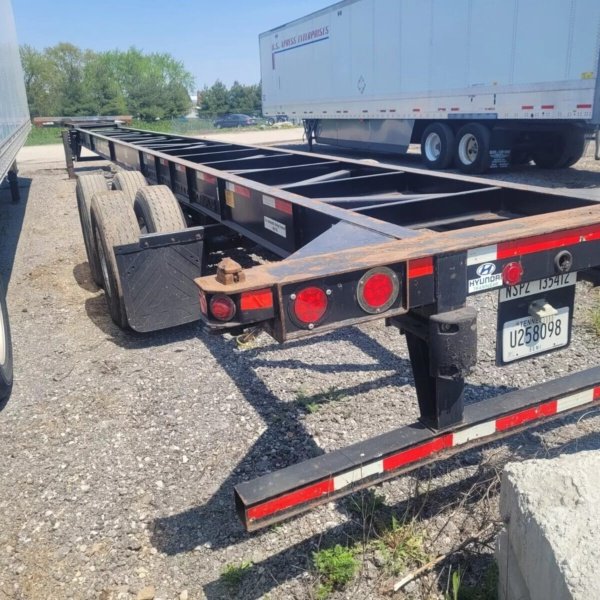
Container Chassis
A container chassis is road running gear, not storage. Strip a trailer back to a skeletal steel frame on axles, set twist locks into the rails at the spacings that match container corner castings, and you have a deck a box can be dropped onto, locked down and hauled away on — never opened, never tipped out, never double-handled. Operators running boxes from yard to rail terminal to port buy one for the reason anyone buys their own transport: it replaces a booked lift, and somebody else’s schedule, with your own.
What to look over on a used skeletal trailer
Twist locks. Every head should turn through its full travel and seat square in the casting. This is the entire load path between box and trailer, so nothing else matters as much.
Rail straightness. Sight down the main rails. A twisted or sagging rail fights you on every lock-down and never stops.
Configuration. Casting positions have to match the container lengths you actually haul.
Suspension and axles. Look for even ride height and the tell-tale signs of a frame that has carried more than its rating.
Tyres, brakes and lighting. The consumables, and the first things to budget for on any used frame.
Stock here is single-unit and turns over as it is sourced. The current listing is a 2011 Hyundai 53ft container chassis, used. At 53ft (16.15 m) that frame is cut for domestic North American intermodal boxes, not the 40ft (12.19 m) ISO lengths making up most of our container stock, so check your casting spacing against it first. Need another length or axle configuration? Send us the haul and we will try to source it.
For the boxes themselves rather than the gear that carries them, see shipping containers and high cube containers. Delivery is free UK-wide, including Northern Ireland, the Isle of Man, Jersey and Guernsey, on a 7–10 day estimate rather than a guarantee; moving a wheeled unit differs from dropping a container, so confirm site access when you order. The price shown is the total payable, with no VAT added at checkout.
Showing the single result