
Description
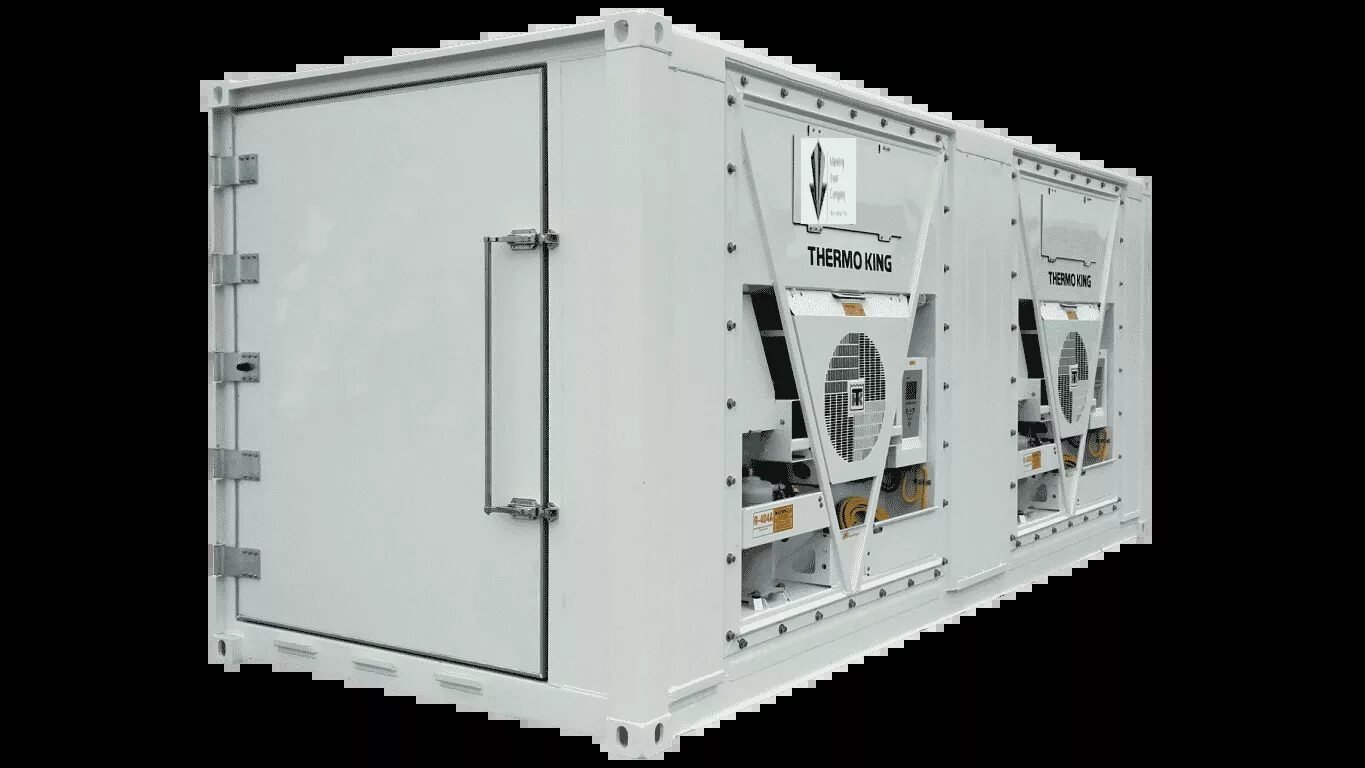
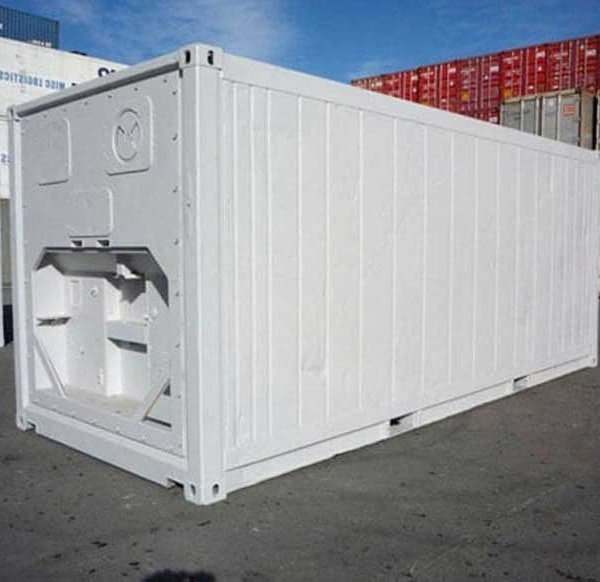
A 20ft container configured as a blast freezer rather than a holding reefer. The difference is not marketing: a standard reefer is designed to maintain a set point, while a blast freezer is designed to drive product through the critical freezing zone as quickly as possible. Doing that quickly keeps the ice crystals small, and small crystals are what protect texture, moisture retention and cell structure in meat, seafood, bakery and prepared meals. A load frozen slowly in a holding unit will reach the same temperature and come out noticeably worse.
Capacity, openings and ratings
- External: 6.06 × 2.44 × 2.59 m (20 ft × 8 ft × 8 ft 6 in)
- Internal capacity: 23.8 m³ (841 cu ft)
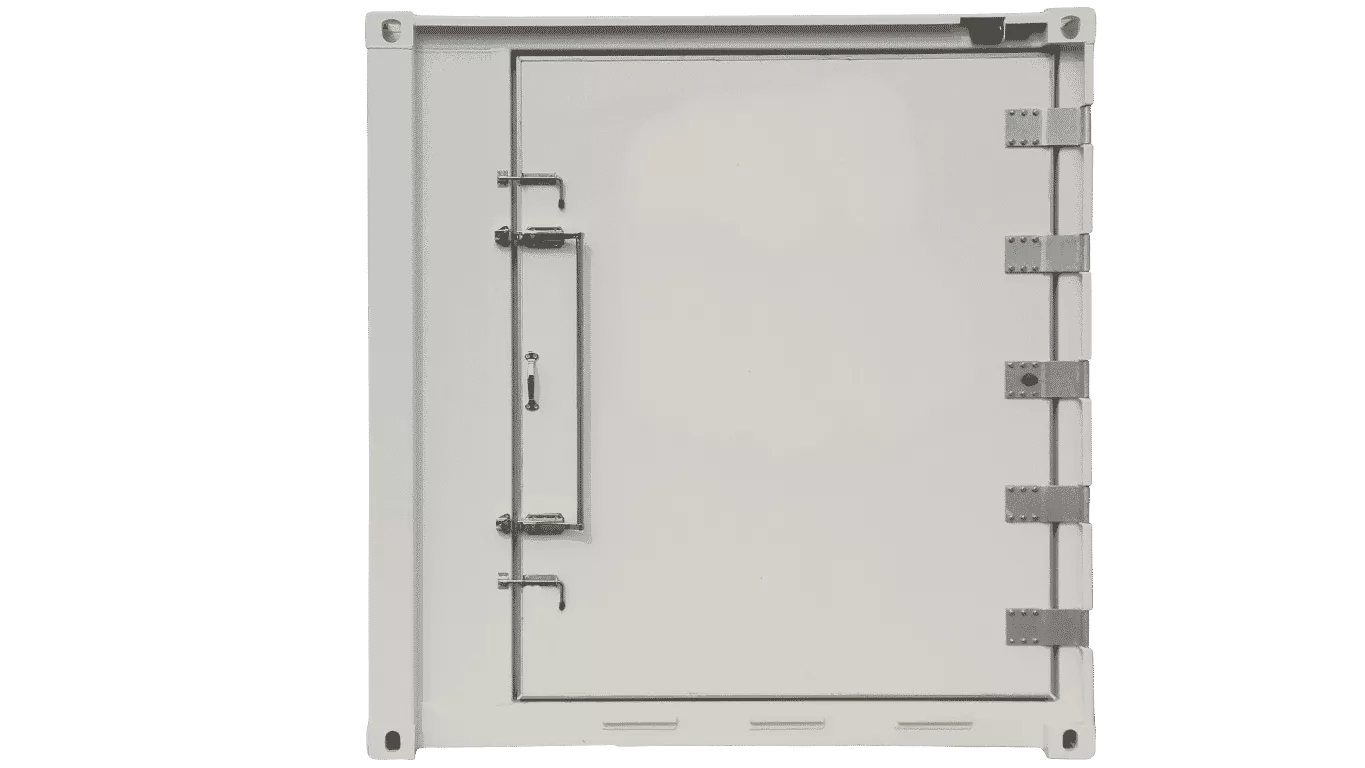
- Door opening: 1,737 mm wide × 2,232 mm high (5 ft 8 in × 7 ft 4 in)
- Cargo access height: 2,232 mm (7 ft 4 in)
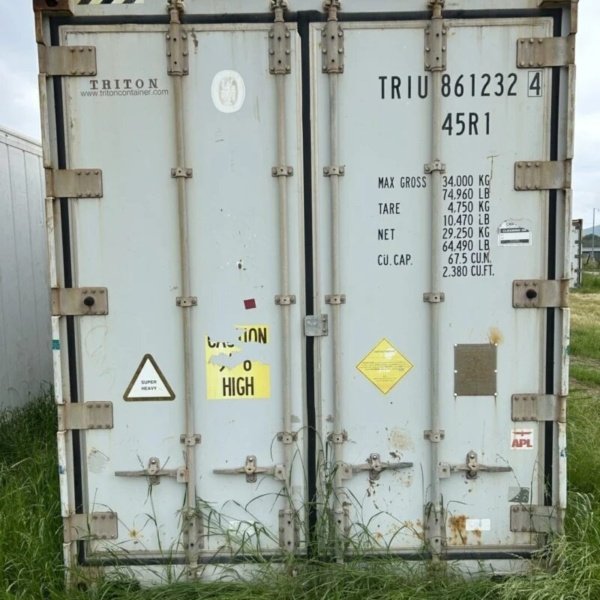
- Tare: 2,710 kg bare, 3,450 kg including the 740 kg refrigeration unit
- Max payload: 20,550 kg · max gross: 24,000 kg
Insulation and sealing
- Roof: 90 mm at 40 kg/m³ density
- Side walls: 65 mm at 45 to 50 kg/m³
- Door panels: 81 mm at 45 to 50 kg/m³
- Floor: 101/51 mm at 45 to 50 kg/m³
- Heat leakage: U max 30 kcal per °C per hour at a mean wall temperature of 293 K (20 °C)
- Air leakage: Q max 14 m³/hr including the reefer unit, measured at 250 ±10 Pa
That insulation package is not a specification detail for its own sake — it is precisely what makes repeatable pull-down rates achievable. A thinner envelope loses the battle against ambient heat gain before the load is frozen.
Operating band and power
The unit is specified across roughly -40 to +21 °C (-40 °F to 70 °F), covering blast freezing at one end and ambient holding at the other. The refrigeration pack is rated for 460V or 230V three-phase operation. UK three-phase is nominally 400V, so confirm the supply arrangement with us before ordering rather than after delivery — this is the single point on this unit most worth settling in advance, and it is not something to assume from the listing.
Loading it properly
- Load in single layers with clear air gaps. Stacking tight defeats the entire purpose of blast freezing
- The 1,737 mm door is narrower than a dry container, so plan pallet handling and trolley widths around it
- Leave clearance for servicing at the machinery end, and set the unit on a level pad so the doors seal squarely
- Work out your batch size against the 23.8 m³ before you buy — blast capacity is per cycle, not per day
Delivery and cover
Delivery is free UK-wide including Northern Ireland, the Isle of Man, Jersey and Guernsey, and the price shown is the total payable with no VAT added at checkout. At 3,450 kg with the machinery fitted, this is a straightforward tilt-bed delivery onto level, load-bearing ground; where the position needs a crane or HIAB offload instead, that is agreed in writing before delivery. Have the three-phase arrangement resolved and commissioned first, because a blast freezer cannot be usefully tested without it. As a new unit it is covered for 12 months against structural defects and water ingress, and separately you keep your 14-day right to cancel under the Consumer Contracts Regulations 2013 and your distinct 30-day right to reject faulty goods under the Consumer Rights Act 2015.
Holding rather than freezing
Holding product that is already frozen is a different job. For that, weigh the 20ft mobile cold storage freezer and cooler against the 20ft Thermo King freezer container. Short of space? A 10ft compact freezer reefer goes where a 20ft cannot. All temperature-controlled stock is under refrigerated containers, and power, siting and specification are dealt with in our buyers guide.
Reviews
There are no reviews yet.