
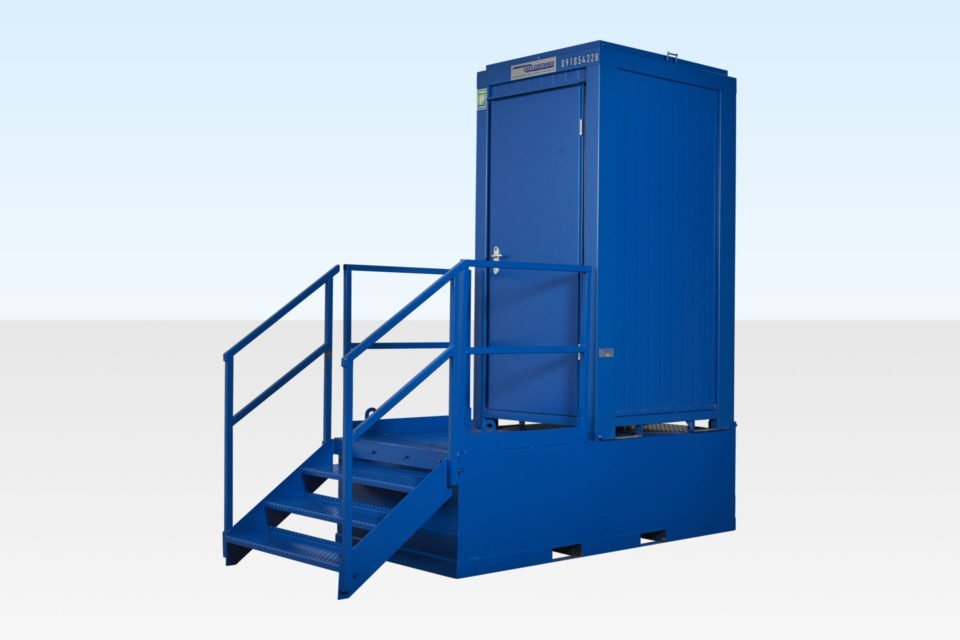
Description
Put a toilet block on ground with no sewer under it and something has to hold what comes out. This is that something: a sealed steel vessel designed to live beneath a jackleg or steel toilet cabin, storing effluent until a tanker draws it off. The constraint you are designing around simply changes character — proximity to a drain stops mattering and tanker access starts. The body is 2 mm steel over an internal framework, primed in black, and the two emptying points sit diagonally opposite one another so the driver is never forced to approach from one particular side.
Dimensions and capacity
- External: 2.515 × 1.23 × 0.61 m (8 ft 3 in × 4 ft 0 in × 2 ft 0 in)
- Capacity: 1,893 litres (500 gallons)
- Emptying points: two at 150 mm (5.9 in), on opposite corners, with covers
- Construction: steel framework clad in 2 mm steel, primed black
Two emptying points is not redundancy, it is access
The second connection looks like a luxury until the block ends up boxed in by hoarding, stacked material or plant that arrived after the toilet did. On a site that changes shape every few weeks, having a corner connection available from either side is often the difference between a straightforward empty and a rescheduled visit with a wasted tanker charge. It costs nothing at the point of specification and repays itself the first time the approach changes.
Specification
- Designed to sit under jackleg and steel toilet cabins
- 2 mm steel cladding over an internal steel frame and supports
- Black primer finish
- Two connections at opposing corners, so a tanker can pull up on either side
- Fully sealed vessel, with nothing to plumb into a mains drain
- Capacity matched to one toilet unit
Sizing the emptying schedule, not the capability
Capacity sets how often the tanker comes rather than whether the arrangement works at all. The same 1,893 litres serving a small crew lasts considerably longer than it does under a busy block at shift change, so set the emptying interval against your actual headcount rather than a nominal figure. Matched to a single toilet unit, this tank is not the right pairing for two cubicles — the double version is.
Delivery, siting and cover
Delivery is free UK-wide, including Northern Ireland, the Isle of Man, Jersey and Guernsey, and the price shown is the total payable with no VAT added at checkout. Site it with tanker access in mind first and the toilet position second — a block that is convenient for the crew but unreachable for a tanker creates a recurring problem. The tank must sit on firm, level ground bearing evenly across its full length, because the toilet unit above it depends on that for its own levelling. Crane or HIAB offload is agreed in writing before delivery. Fabrication workmanship is covered for 12 months, and separately you have 14 days to change your mind under the Consumer Contracts Regulations 2013 and a 30-day right to reject the goods if faulty under the Consumer Rights Act 2015.
Choosing the right pairing
Serving two cubicles rather than one moves you to the double mains toilet waste tank. If the block itself is still undecided, the 8ft x 5ft mains toilet and shower unit and the 1+1 double mains toilet in green are the usual starting points — settle the cabin, then size the tank to it. The rest of the welfare range sits under specialised containers, and when you request a quote it helps to say which toilet unit you are running and the headcount it has to carry.
Reviews
There are no reviews yet.